

From Aluminium Rod to Grid-Ready Conductor: Inside PIPL’s Manufacturing Process
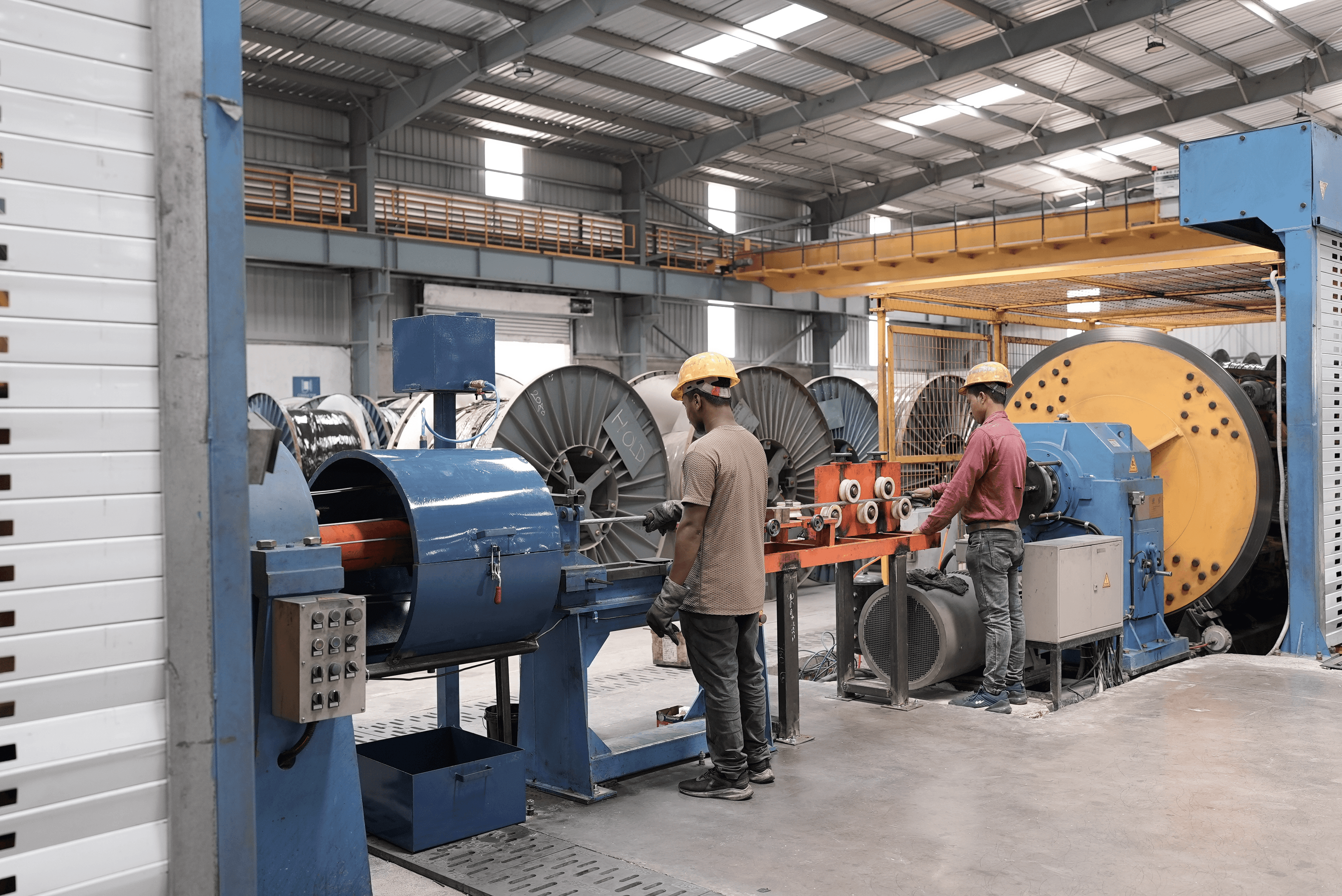
How aluminium rod is transformed into grid-ready overhead conductors through controlled wire preparation, stranding, inspection, testing and traceability at PIPL.
Building a Reliable Conductor
Electricity travels through an extensive network of generation, transmission and distribution infrastructure before reaching homes, industries and businesses. At the heart of this network are conductors—the engineered products that carry electrical current across power lines.
A conductor is much more than aluminium wires brought together into a finished construction. Producing a reliable conductor requires control at every stage, beginning with the incoming raw material and continuing through wire preparation, stranding, inspection, testing and final dispatch.
At Palriwal Industries Private Limited (PIPL), the manufacturing approach is built around a straightforward principle: consistent raw materials, controlled processes and disciplined quality inspection are essential to producing conductors that meet defined product and customer requirements.
From Aluminium Rod to Conductor
1. Raw-Material Inspection
The manufacturing journey begins with the selection and inspection of aluminium rod. Incoming material is checked against applicable product and customer requirements before being released for production.
This stage is important because the quality and consistency of the starting material directly influence subsequent manufacturing processes and the characteristics of the finished conductor.
2. Wire Preparation
The aluminium rod is processed into wires of the required diameter. Dimensional consistency is a key requirement at this stage.
The objective is not simply to achieve a nominal diameter, but to maintain stable dimensions and appropriate surface condition along the wire so that the subsequent stranding operation can produce the specified conductor construction.
3. Stranding
Individual aluminium wires are brought together through the stranding process and arranged in a controlled geometric construction according to the conductor design.
The number of wires, their arrangement and lay characteristics depend on the relevant product specification. Accurate stranding is therefore essential to achieving the required construction and dimensional characteristics of the finished conductor.
Process Control: Quality Is Built In
Manufacturing quality is created during production—not simply checked at the end.
Process monitoring and in-process inspection help identify variation early and support timely corrective action. Typical controls may include dimensional checks, monitoring of process parameters, construction verification, surface-condition checks and production-batch traceability.
This approach helps prevent small process deviations from developing into larger production or quality issues. In conductor manufacturing, consistency from one stage to the next is as important as the final inspection result.
Dimensional Accuracy and Conductor Construction
Dimensional accuracy is a functional requirement rather than merely a cosmetic consideration.
The finished conductor must achieve its specified construction along with the relevant dimensional and performance characteristics. Applicable standards define requirements for conductor construction and properties, while individual customer specifications may establish additional requirements.
In-Process and Final Inspection
A robust quality system does not depend entirely on final inspection. In-process checks create opportunities to identify variation while production is still underway.
Once manufacturing is complete, the finished conductor undergoes final inspection and testing in accordance with the applicable product specification and customer requirements.
Depending on the conductor type and specification, relevant checks can include dimensional verification, mechanical properties, electrical resistance and construction-related parameters.
The objective is to provide documented evidence that the supplied product has been manufactured and evaluated against defined requirements.
Traceability, Drum Winding and Dispatch
Following approval, the finished conductor is wound onto drums suitable for handling, transportation and installation.
Careful handling at this stage helps protect the product and maintain its identification. Traceability connects the finished conductor with its manufacturing and inspection history and supports quality documentation, customer requirements and manufacturing control.
Why Process Discipline Matters
A power conductor can remain in service for many years after leaving the manufacturing facility and may be exposed to electrical, mechanical and environmental stresses throughout its operating life.
For this reason, conductor manufacturing cannot depend on final appearance alone. Quality has to be built progressively into the process—from raw-material inspection and wire preparation to stranding, testing and final dispatch.
The Manufacturing Chain
- Raw-Material Inspection
- Aluminium Rod
- Wire Preparation
- Dimensional & Process Control
- Stranding
- In-Process Inspection
- Final Testing
- Drum Winding & Identification
- Traceability & Dispatch
From the Manufacturing Floor to the Power Grid
The journey from aluminium rod to a grid-ready conductor involves a sequence of controlled operations, but the objective remains straightforward: manufacture a conductor that consistently meets its specified requirements and is supported by disciplined manufacturing, inspection and documentation.
At PIPL, every stage—from incoming raw material to the finished drum—contributes to the final product. The conductor reaching the customer is therefore not simply the result of one machine or operation, but the outcome of coordinated process control, skilled people, quality checks and traceability.
Frequently Asked Questions
What is the starting material for an aluminium conductor?
Aluminium rod is commonly used as the starting material and is processed into wires of the required dimensions before stranding.
Why is wire diameter important?
Wire diameter influences conductor construction and dimensional characteristics. Maintaining consistent dimensions supports conformity with the specified conductor requirements.
What is stranding?
Stranding is the process of arranging individual wires into a specified geometric construction to produce the finished conductor.
Why is traceability important?
Traceability connects the finished conductor with its production and inspection history and supports quality documentation, customer requirements and manufacturing control.
Is the conductor tested after manufacturing?
Yes. Final inspection and testing are performed in accordance with the applicable product specification and customer requirements. Depending on conductor type, this may include dimensional, mechanical, electrical and construction-related checks.
Abhishek Kumar Singh, DGM – Production (Conductor & Cable)
Palriwal Industries • Published 15 October 2026
Let's build something together.
Explore our product lines, visit our manufacturing facility, or get in touch with our team to discuss your next project.